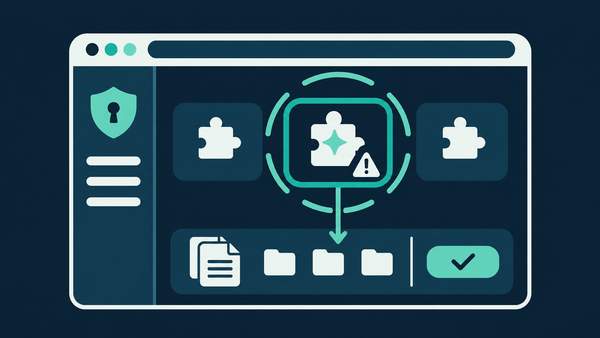
An employee pastes confidential meeting notes into an AI chatbot to prepare a client update. Another connects an AI assistant to a shared drive so it can find documents more quickly. Both are trying to save time, but each may have made a decision about company information and system access without anyone reviewing the implications.
That is the central difficulty with shadow AI: employees can bring powerful tools into everyday workflows faster than the business can establish rules for using them. Treating every employee as a security problem misses the reason these tools spread. Businesses need rules that make legitimate uses straightforward and unsafe ones easier to recognize.
Where Unapproved AI Enters the Business
Shadow AI refers to AI tools, plug-ins, or agents adopted without the organization’s approval or security review. It may involve a personal chatbot account used for writing, a transcription service invited to meetings, or a browser extension that quietly processes information from company systems.
A tool can be familiar and still raise unanswered questions. Which files does it receive, and does the vendor retain them? Who can access the output, and is the employee using a personal subscription or a company-managed account?
The answers depend on the tool, its configuration, and the information involved. Rewriting a public product description presents different concerns from uploading patient records or unpublished financial information. Without visibility, the company cannot distinguish those uses reliably.
Nexus Security Advisors helps small and mid-sized businesses find AI tools already in use and examine the information they touch. Its AI governance consulting combines shadow AI discovery with practical controls, helping leadership decide which uses can continue, which need different settings, and which require additional approval.
Find Out What Employees Are Trying to Accomplish
A company might begin with an approved-tools policy and discover that staff use other products anyway. The better starting question is what those tools make possible: faster proposals, cleaner meeting notes, quicker comparisons, or relief from repetitive document work.
Suppose a customer-support employee has adopted an AI browser extension to summarize incoming requests. Simply removing it may leave the employee with the same overloaded queue and no approved alternative. Understanding the workflow helps the business evaluate whether its existing software can perform the task, whether another approved tool is appropriate, or whether that particular use is too risky.
A meaningful inventory therefore records more than product names. It connects each tool with a business purpose, the people using it, the information it can reach, and the decisions its output may influence. An application that drafts internal notes belongs in a different review category from an agent that can update customer records.
Nexus offers an AI Readiness & Use-Case Sprint to uncover existing AI use, rank opportunities by value and risk, and produce a 90-day roadmap. Businesses that already know they need a governance framework can instead examine the separate AI Governance Program, which covers inventories, policies, risk ownership, and vendor controls. Both are fixed-scope packages. See current pricing at nexussecurityadvisors.com.
Give Employees Rules They Can Apply Without Guessing
An instruction to “use AI responsibly” leaves employees to interpret what responsible means under deadline pressure. If someone is drafting a customer email, can they include the customer’s original message? If a manager wants a confidential report summarized, which approved service can process it, and who authorizes an exception?
A usable policy answers those questions with examples, approved uses, restricted data, and a simple path for proposing new tools. It should explain when company-managed accounts are required, what review AI-generated content needs, and who employees should contact when they are uncertain.
For example, an employee may be permitted to use an approved application to edit a public announcement but prohibited from uploading unapproved copies of customer files. An AI assistant might be suitable for drafting a response while the person responsible for the customer relationship must still verify facts and approve what is sent.
The AI Governance Program from Nexus includes an acceptable-use policy, AI inventory, risk register, and vendor and data-handling requirements. Those deliverables give managers a consistent way to approve or restrict uses instead of relying on personal assumptions about which tools seem safe.
Clear rules can also discourage employees from hiding AI use. People have a better reason to ask permission when they know who decides and how to obtain an answer without derailing their work.
Separate AI Assistance From Authority to Act
Drafting a report and approving a payment are different activities, even if the same AI system can assist with both. Businesses need to decide where an AI tool may suggest an action and where a named person must review and authorize it.
Imagine a finance team using AI to organize invoice details. It may be reasonable for the system to identify missing fields or prepare a draft for review, but giving it permission to approve payments or change supplier bank details creates a much more consequential responsibility.
This difference becomes sharper with AI agents connected to email, shared drives, customer relationship management software, or internal databases. An agent can inherit access to far more information than it needs for its assigned task. Manipulated instructions can steer it toward revealing information or performing an unauthorized action, a risk known as prompt injection (LLM01) in the OWASP Top 10 for Large Language Model Applications.
Nexus addresses these issues through agent identity, least-privilege access controls, and AI security testing. In practical terms, an assistant should receive only the permissions needed for its job, while significant actions remain subject to human approval. Testing can help find weaknesses before the system becomes part of an important workflow.
Nexus aligns its AI governance approach with the National Institute of Standards and Technology’s AI Risk Management Framework (NIST AI RMF) and ISO/IEC 42001, the international standard for AI management systems.
Give AI Governance an Owner and a Reason to Continue
An employee discovers a new application, a vendor introduces a feature, or a department connects an assistant to more data. Each change can alter what the organization has authorized, making a policy that was adequate at launch less reliable months later.
An effective program therefore needs someone responsible for reviewing proposals, maintaining the inventory, responding to incidents, and checking whether agreed controls still operate as intended. That responsibility might sit with an internal leader supported by specialist advice rather than require a new full-time department.
Nexus’s AI Governance Program helps establish those responsibilities. Its Fractional AI Advisor service provides ongoing guidance on AI applications, vendors, agent permissions, and new requirements.
Bring AI Use Under Better Oversight
Employees will keep finding tools that make their work easier. The stronger response is to identify which uses the business can support, establish appropriate controls, and assign responsibility for approving new applications.
As a no-cost first step, use the vendor-neutral Shadow AI Detection Pack from Nexus Security Advisors to look for signs of unapproved AI use in logs your team already collects. Request a free 30-minute discovery call to discuss the AI tools already in use and the governance support your business needs.